
Published by FutureTecEra

Artificial intelligence is now part of many digital workflows. Content teams use it to organise ideas, small businesses use it to prepare information, and creators use it to assist with research, planning, communication, and review. Yet simply adding AI tools to a project does not automatically make the work clearer, more responsible, or more valuable.
The important question is not how many AI tools a business uses. It is how those tools fit into a system: what purpose they serve, what information they receive, which tasks they assist with, what boundaries guide their use, and where a person remains responsible for reviewing the result.
AI Business System Design is a practical way to think about these questions. It focuses on building connected workflows in which artificial intelligence assists with defined tasks without replacing human judgment, privacy safeguards, editorial responsibility, or the values that shape a digital project.
In this FutureTecEra guide, you will explore how scattered AI use can become a more organised system. The goal is not to present automation as a substitute for planning, review, or responsible decision-making. The goal is to guide creators, small teams, and digital project owners toward workflows that are understandable, reviewable, adaptable, and responsible.
Exploring responsible ways to use AI in digital work?
Begin with FutureTecEra‘s introductory learning path to understand how artificial intelligence can guide digital skills, clearer workflows, and thoughtful human review before you design a broader AI-informed system.
Why AI Business System Design Matters Beyond Individual Tools
A single AI tool can assist with one defined task. It may suggest an outline, summarise approved notes, prepare alternative wording, organise a list of questions, or highlight information that deserves review. These uses can be practical, but they do not by themselves create a reliable workflow.
Problems often appear when tools are introduced without a clear structure. One tool may generate draft material, another may reorganise it, and a third may distribute or store it, while no one has clearly defined which information is approved, what should be checked, or who is responsible for the final decision.
This is why AI Business System Design matters. It moves attention away from isolated features and toward the relationships between purpose, information, tasks, review points, and refinement over time. A responsible system does not begin by asking, “Which tool should be added next?” It begins by asking, “What process needs assistance, and what safeguards should remain visible?”
For a small digital project, this distinction can affect many everyday activities:
- Preparing content ideas without publishing unverified claims.
- Organising audience questions without collecting unnecessary personal information.
- Using AI-assisted summaries while checking them against original sources.
- Drafting replies or documentation while keeping important communication under human review.
- Reviewing recurring tasks before deciding whether automation is appropriate.
A well-designed workflow therefore does not treat AI as the identity of the project or as a substitute for judgment. It treats AI as one assistance layer inside a process that already has a purpose, clear boundaries, and a person accountable for what is ultimately used or published.
Core Principle
Responsible AI Business System Design begins with a clear workflow and human responsibility. Tools should be included only where they serve a defined purpose and can be reviewed appropriately.
What Responsible AI Business System Design Means
AI Business System Design is the practice of organising AI-assisted tasks inside a clear digital workflow. It asks how information enters the system, how it is handled, which activities may involve AI assistance, which decisions require human review, and how the workflow can be refined without weakening privacy, trust, or clarity.
This approach is different from collecting tools or turning every repeated activity into automation. A system can be simple and still be well designed. For example, a content creator may use AI only to organise verified research notes, compare outline options, and prepare a revision checklist. The value comes from knowing where the tool fits and where direct human judgment remains necessary.
Responsible design also recognises that digital work is not only about speed or visible activity. A well-designed workflow should allow a project to maintain accuracy, protect information, serve its audience appropriately, document important decisions, and avoid unnecessary complexity.
| Design Question | Why It Matters | Responsible Example |
|---|---|---|
| What is the purpose? | A workflow needs a clear educational, editorial, or operational objective. | Use AI to organise approved article notes before human drafting and review. |
| What information enters? | Inputs may contain inaccurate, unnecessary, or private details. | Provide only relevant source material and remove identifying information when not needed. |
| What can AI assist with? | AI assistance should remain limited to tasks where review remains practical. | Request outline options, summaries for checking, or clearly labelled draft material. |
| What remains human? | Important decisions require context, responsibility, and judgment. | A person verifies sources, approves language, and decides what is published. |
| How is the workflow refined? | Refinement should be based on clarity and reliability, not activity alone. | Record repeated errors, unclear instructions, and approved revisions for later refinement. |
These questions distinguish a thoughtful system from an accumulation of disconnected tools. The purpose is not to make a digital project more dependent on AI. It is to decide carefully where AI assistance adds clarity and where human attention must remain central.
Core Layers of an AI-Informed Workflow
A responsible AI-informed workflow can be understood through a set of connected layers. These layers are not software products or technical requirements. They are design considerations that guide a business, creator, or small team in organising work before introducing unnecessary complexity.
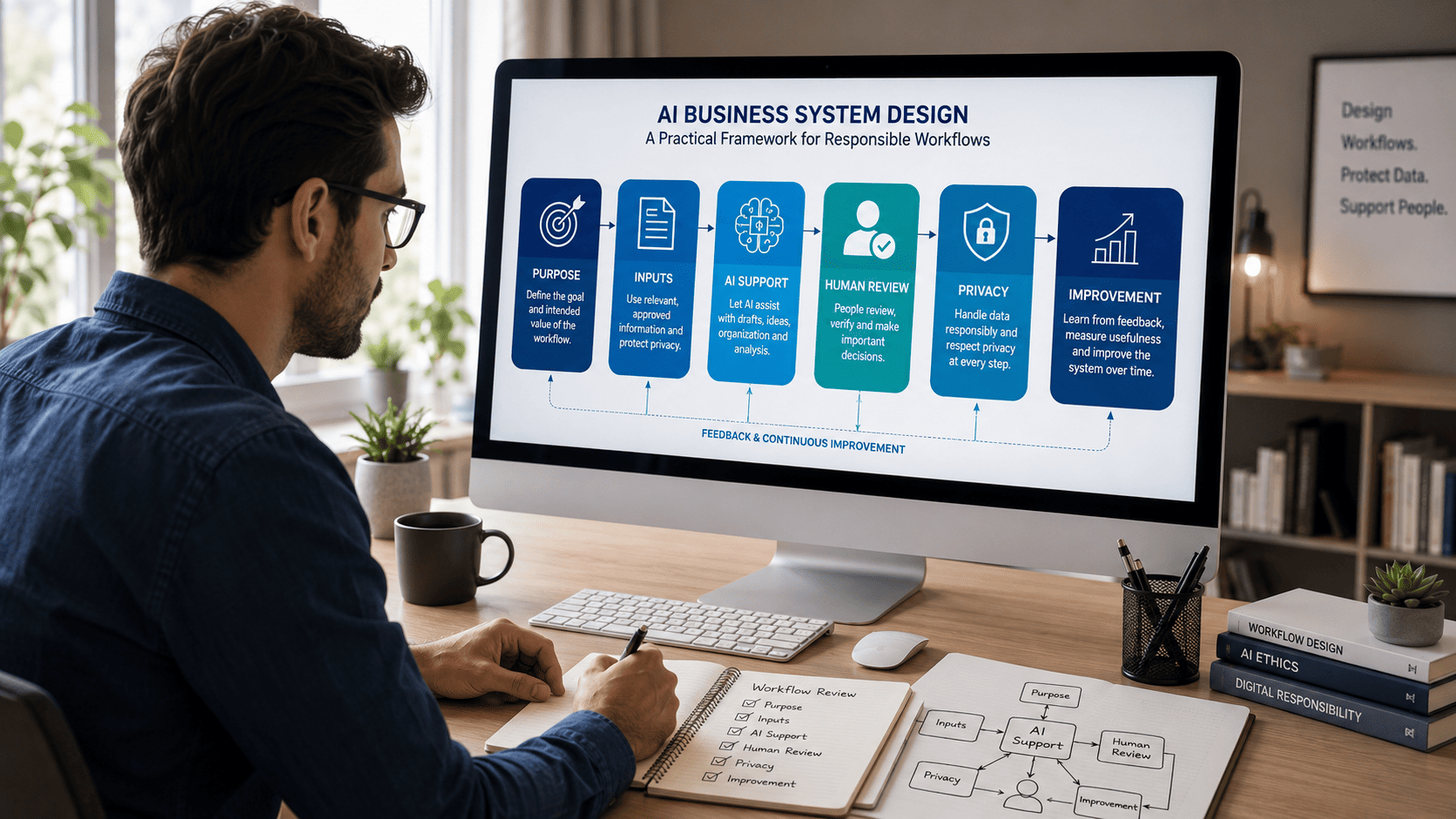
Each layer has a different role. The purpose layer explains why the workflow exists. The input layer determines what information is allowed into the process. The activity layer defines where AI may assist. The oversight layer protects decisions that need human responsibility. The review layer allows the workflow to become clearer through evidence and reflection.
Purpose and Intended Value
Every system should begin with a reason for existing. A digital workflow may be designed to prepare clearer educational articles, organise customer questions for review, maintain an internal knowledge base, strengthen accessibility in written materials, or assist a small team with recurring documentation.
Without a defined purpose, AI-informed activity can become difficult to evaluate. A project may generate more material, collect more information, or introduce more automated actions without knowing whether those activities are genuinely valuable to the audience or the organisation.
Defining purpose also reduces unnecessary automation. When a task does not serve the intended value of the workflow, it may not deserve additional tools, data collection, or automated processing.
Relevant Inputs and Responsible Data Use
An AI-informed workflow depends on the information it receives. Inputs may include approved content notes, anonymised audience questions, public product information, documentation drafts, service categories, feedback summaries, or internal review records.
Good input design does not mean collecting everything available. It means deciding what information is relevant, accurate enough for the task, and appropriate to use. Sensitive personal details, private communications, unpublished material, or identifying data should not be included simply because a tool can process them.
A responsible system therefore documents what types of information may enter the workflow, what should be removed or anonymised, and what requires special approval before use.
Workflow Structure and Appropriate AI Assistance
After the purpose and inputs are clear, the next question is where AI assistance can fit into the process. Not every task requires the same level of assistance, and not every task should be automated.
For a beginner-focused framework that explains how one workflow can move from approved inputs to AI-assisted preparation, human review, authorized action, and regular maintenance, explore:
AI Workflow Automation for Beginners
For example, AI may be practical for grouping common questions, preparing alternative headings, summarising approved notes for review, converting a verified outline into a draft checklist, or highlighting areas in a document that may need clearer language.
These activities are simpler to supervise because the user can compare the output with the original purpose and source material. In contrast, automatically publishing content, issuing sensitive communications, or making important decisions without review introduces risks that a responsible workflow should avoid.
Decision Boundaries and Human Review
A clear system defines the difference between assistance and decision-making. AI can organise information and prepare options, but people remain responsible for interpreting context, considering consequences, approving public material, protecting privacy, and ensuring that the work reflects the intended values of the project.
Human review points should be visible rather than implied. A content workflow might require an editor to verify important claims before publication. A customer service workflow might require a person to review sensitive cases. A learning-resource workflow might require an educator to check whether explanations are accurate and suitable for the audience.
These review points do not weaken the value of the workflow. They make it more accountable and clearer to trust.
Feedback and Responsible Refinement
A responsible workflow should allow careful refinement, but refinement must be understood carefully. It is not simply an increase in output, activity, messages sent, or tasks completed. A workflow becomes more valuable when it produces clearer material, reduces avoidable confusion, protects information more consistently, and gives reviewers clearer context.
Feedback may come from reader questions, editorial corrections, recurring service issues, accessibility concerns, inaccurate summaries, or staff observations about where a process remains unclear. AI may assist with organising these signals, but a person should still decide what they mean and which changes are appropriate.
This is the broader purpose of AI Business System Design: to create a structure in which assistance, oversight, and refinement work together without presenting automation as a substitute for responsibility.
From Fragmented Tasks to Connected Workflows
Many digital projects begin with separate tasks. One tool is used for drafting ideas, another for storing notes, another for preparing messages, and another for reviewing results. This arrangement may appear practical at first, but it can become difficult to manage when the purpose of each task, the source of each piece of information, and the person responsible for final review are not clearly documented.
A connected workflow is different. It does not necessarily use more technology. It establishes a clear path from approved input to assisted activity, human checking, final use, and later refinement. This path can reduce duplicated effort, unclear ownership, unnecessary data exposure, and the accidental use of unverified material.
| Workflow Area | Fragmented Approach | Responsible System Approach |
|---|---|---|
| Content planning | Generate topics without checking relevance or source quality. | Begin with audience needs, approved notes, and editorial review criteria. |
| Document summaries | Accept an AI summary as though it were the source itself. | Use summaries for orientation, then check important points against the original material. |
| Audience feedback | Collect extensive data without a clear purpose. | Review only relevant feedback signals and protect identifying information. |
| Public communication | Publish or send generated material without appropriate checking. | Keep a human approval point before external publication or sensitive communication. |
| Workflow refinement | Add more tools whenever a difficulty appears. | Identify the source of friction before changing the workflow or adding assistance. |
Moving from fragmented tasks to connected workflows does not require an elaborate technical system. It begins with a documented purpose, clearly defined information sources, reasonable boundaries, and review points that remain visible as the project develops.
Common Design Mistakes Before Introducing Automation
Automation can be practical when a workflow is already understood and carefully bounded. It becomes less appropriate when it is introduced into a process that has no clear objective, no review standard, or no agreement about which information is appropriate to use.
The following design mistakes are common in AI-informed digital work. Understanding them early can guide a project toward a simpler, clearer, and more responsible workflow.
Automating an Unclear Process
A process should not be automated simply because it is repeated. Before adding AI assistance, it is important to understand what the task is meant to accomplish, which information it depends on, what a valuable result looks like, and who checks the outcome.
For example, using AI to prepare content drafts may be reasonable when approved sources, audience needs, and editorial requirements are already defined. Automating draft production without these elements can multiply unclear or unverified material rather than refine the workflow.
Collecting More Information Than the Task Requires
Some systems gather information simply because it may be available. This can create privacy concerns, confusion, and unnecessary review work. A responsible workflow uses only information that is relevant to its purpose and handles it with appropriate care.
If a task can be completed with anonymised examples, approved summaries, or limited data fields, there may be no reason to include names, private records, detailed personal histories, or other information that is not needed.
Treating Generated Content as Final Content
AI-generated material can appear polished while still containing inaccurate, incomplete, outdated, or unsuitable information. This is especially important for public articles, technical guidance, product descriptions, learning resources, and communications that affect other people.
A responsible system treats generated material as a draft, suggestion, summary, or review aid until an appropriate person has checked its clarity, factual basis, tone, and suitability for the intended use.
Measuring Activity Instead of Quality
A workflow may produce more drafts, more summaries, more reports, or more automated actions without becoming more valuable. Quantity alone does not show whether the system serves readers, protects trust, makes understanding clearer, or reduces avoidable mistakes.
More responsible review questions include whether the material is clearer, whether important claims were verified, whether sensitive information was protected, whether recurring confusion was reduced, and whether human reviewers can still understand and supervise the workflow.
Adding Tools Without Clarifying Responsibilities
Introducing additional tools can create overlapping tasks and unclear ownership. A project may no longer know which version of a document is approved, which output has been checked, or where private information is stored.
Before adding another AI-informed function, a responsible team should ask whether it serves a defined purpose, whether it fits the existing workflow, whether its output can be reviewed, and whether its information practices are suitable for the project.
| Design Mistake | Possible Concern | Clearer Design Choice |
|---|---|---|
| Automating before defining the purpose | The system may repeat unclear or unnecessary activity. | Document the objective, source material, and review standard first. |
| Using unnecessary private information | Sensitive details may enter a workflow without a clear need. | Limit inputs and anonymise information wherever appropriate. |
| Removing review points too early | Errors or unsuitable wording may reach the audience unchecked. | Keep human approval visible for important material and decisions. |
| Focusing only on output volume | More activity may hide lower clarity or reduced trust. | Evaluate clarity, reliability, privacy, and audience value. |
| Adding tools without workflow documentation | Responsibilities and approved versions may become unclear. | Map the process and ownership before introducing additional assistance. |
These mistakes do not mean that AI assistance should be avoided. They show why AI Business System Design should begin with structure rather than enthusiasm around tools. When purpose, inputs, boundaries, review, and refinement are clear, technology can assist the workflow without controlling it.
The visual framework that follows allows readers to see how these elements connect before the article moves into practical applications, workflow evaluation, and responsible governance.

Want to explore how connected AI-informed workflows can work together?
After reviewing the foundations of AI Business System Design, you may find it valuable to explore how individual workflows can connect within a broader digital system while keeping purpose, boundaries, and human oversight visible.
Our companion guide to AI-Powered Online Business Systems explores this broader system perspective through connected digital workflows built around clear purpose, responsible boundaries, and visible human oversight.
Explore AI-Powered Online Business SystemsKeeping Human Judgment Visible in AI-Informed Systems
A well-designed digital workflow does not become responsible simply because it includes artificial intelligence. Responsibility depends on whether people can understand the purpose of the system, review important outputs, correct mistakes, protect sensitive information, and decide when an automated action should not continue.
Within AI Business System Design, human judgment is not an optional addition placed at the end of the process. It is a visible control layer that guides how the workflow is planned, what information may be used, where AI assistance is appropriate, and which decisions must remain with a person.
This matters because AI-informed systems can influence more than the speed of a task. They can affect what information is prioritised, how questions are grouped, which drafts are developed further, how content is presented, and what patterns are interpreted as meaningful. These activities require context and responsibility, not only automation.
Review Decisions That Require Context
Some activities are suitable for AI assistance because a person can review the result clearly. For example, an AI tool may assist with organising approved notes, identifying repeated themes in anonymised feedback, suggesting alternative headings, or preparing a checklist from material that has already been verified.
Other activities require direct human review. Publishing factual claims, responding to sensitive situations, interpreting audience needs, approving changes to important content, or deciding how private information should be handled cannot be delegated simply because an automated option is available.
A responsible workflow therefore identifies review points in advance. It does not wait until an error appears publicly before deciding that human oversight was necessary.
Use Restraint When Adding AI Assistance
A digital project does not need to automate every repeated task. In many cases, a responsible choice is to use AI only where it strengthens organisation or assists review without introducing unnecessary risk or confusion.
Restraint can have practical value. It allows a creator or small team to avoid duplicated tools, unclear responsibilities, excessive data collection, and outputs that become difficult to verify. A smaller, clearly understood workflow can be simpler to supervise than a complex system with unclear responsibilities.
- Use AI assistance only where the task has a defined purpose.
- Keep human approval visible for public or sensitive material.
- Limit input data to what is genuinely needed.
- Document what the tool assists with and what it must not decide.
- Review recurring problems before adding new automation.
Build Trust Through Clear and Consistent Practice
Trust in an AI-informed workflow is not created by claims about innovation. It develops when users and team members can understand how information is used, where AI contributes, how outputs are checked, and who remains accountable for final decisions.
For public-facing digital work, this may mean verifying content before publishing, protecting private information, avoiding misleading language, explaining the purpose of automated assistance where appropriate, and correcting problems when they are identified.
A responsible system is therefore not designed to hide human involvement. It is designed to make human responsibility clearer.
Human Oversight Principle
AI may assist with organisation, drafting, comparison, and pattern review. A person should remain responsible for sensitive information, important claims, public communication, ethical boundaries, and final approval.
Practical Uses for Digital Creators and Small Teams
The value of AI Business System Design becomes clearer when it is connected to ordinary digital work. A responsible system does not need to be large or highly technical. It may simply connect a few recurring tasks in a way that makes their purpose, inputs, review requirements, and refinement process clearer.
The examples below show how AI assistance can be used inside practical workflows without presenting automation as a substitute for professional care or human judgment.
Content Research, Drafting, and Editorial Review
A content-focused project may involve topic planning, source collection, outline preparation, drafting, image selection, metadata writing, proofreading, and later updates. When these activities are handled separately without clear documentation, it becomes easy to lose track of which information has been verified and which text is still only a draft.
An AI-informed workflow can assist with organising approved research notes, suggesting possible article structures, identifying repeated ideas, preparing editing checklists, or highlighting sentences that may require fact-checking. The final article should still be reviewed by a person who understands the topic, the intended reader, and the editorial standards of the site.
- Suitable assistance: organising verified notes, comparing outline options, identifying unclear passages, preparing revision checklists.
- Required human review: verifying claims, approving tone, checking originality, confirming links, and deciding what is published.
- Privacy consideration: avoid pasting private communications or unnecessary identifying information into a content workflow.
Digital Learning Resources and Educational Content
Creators who prepare tutorials, learning guides, study resources, or beginner-friendly explanations often need to review whether content is clear, accessible, accurate, and suitable for learners with different levels of experience.
AI may assist by suggesting simpler explanations, organising common questions, creating draft glossaries from approved material, or identifying sections that may need additional clarification. However, an educator or content reviewer should determine whether the final material is educationally appropriate and whether any information requires further verification.
- Suitable assistance: draft summaries, question grouping, accessibility suggestions, alternative explanations.
- Required human review: accuracy, learner suitability, fairness, clarity, and the handling of any learner-related information.
- Privacy consideration: use anonymised or generalised learning feedback rather than identifiable learner records wherever possible.
Small Service Teams and Organised Communication
A small team may receive recurring questions, prepare documents, organise appointments, maintain project notes, or draft routine communications. AI-informed workflows can assist with sorting non-sensitive requests, preparing draft summaries, identifying missing information, or creating consistent document structures.
These uses can make information simpler to manage, but communications that affect a person directly should remain subject to review. Sensitive questions, complaints, personal records, contracts, or decisions with significant consequences should not be handled as though a generated answer were automatically sufficient.
- Suitable assistance: organising request categories, drafting non-sensitive templates, summarising approved project notes.
- Required human review: sensitive responses, commitments, factual accuracy, and communication tone.
- Privacy consideration: keep confidential or identifying information out of the workflow unless its inclusion is necessary and appropriately protected.
Internal Knowledge and Documentation Workflows
Small organisations and independent creators often accumulate notes, guides, policies, project decisions, and frequently asked questions over time. Without organisation, important information becomes difficult to retrieve and update.
AI can assist with categorising approved documents, preparing draft indexes, comparing versions, identifying repeated topics, or highlighting areas where documentation may be outdated. The workflow remains responsible when the source material is controlled, important changes are reviewed, and confidential information is handled carefully.
| Digital Workflow | Possible AI Assistance | Human Responsibility |
|---|---|---|
| Content publishing | Organise notes, compare headings, prepare editing prompts. | Verify information and approve final publication. |
| Learning resources | Suggest clearer explanations and organise learner questions. | Confirm educational accuracy and learner suitability. |
| Service communication | Prepare draft templates and sort routine request themes. | Review sensitive communication and final commitments. |
| Knowledge organisation | Group approved records and flag possible update needs. | Protect confidential information and approve revisions. |
Across these uses, the same principle applies: AI can assist with organising and preparing material, while people remain responsible for accuracy, context, privacy, audience impact, and final use.
Common Misunderstandings About AI Business System Design
The phrase AI Business System Design can sound highly technical or overly ambitious if it is not explained carefully. In practice, it does not require a large organisation, constant automation, or a complicated collection of tools. It begins with understanding a workflow and deciding responsibly where AI assistance may be appropriate.
It Is Not Limited to Large Organisations
A small team or independent creator can benefit from clearer workflow design just as much as a large organisation. A simple system for organising approved research, reviewing drafted material, or managing repeated documentation can already reduce confusion and make responsibility clearer to maintain.
The central requirement is not a large budget or technical infrastructure. It is a clear purpose, appropriate information handling, defined review points, and a willingness to refine the workflow carefully over time.
It Does Not Remove the Need for Strategy
AI-informed workflows cannot decide what a project should value, which audience it should serve, what standards it should follow, or what risks should be accepted. These are human decisions that shape the purpose and boundaries of the system.
When a project adopts AI tools before defining these questions, the workflow may become active without becoming valuable. Responsible design begins with intention, not automation.
More Tools Do Not Automatically Create a Clearer System
Adding tools may appear to offer more options, but it can also create duplicated work, scattered information, unclear approvals, and additional privacy concerns. A well-designed workflow uses only the assistance that serves its purpose and can be supervised effectively.
In many cases, refining the organisation of a current process is more valuable than introducing another application simply because it offers new features.
AI Assistance Requires Careful Review Over Time
Introducing AI assistance may reveal unclear instructions, poor source organisation, weak documentation, or missing review standards. These findings are not signs that the workflow has failed; they indicate areas that need attention before more assistance is introduced.
Careful refinement usually comes through review: identifying recurring issues, adjusting the process, clarifying responsibilities, and observing whether the revised workflow produces clearer, more reliable, and appropriate outputs.
Automation Does Not Remove Human Responsibility
Even where an AI-assisted task becomes routine, a person remains responsible for deciding whether the workflow is appropriate, whether its information use is acceptable, whether outputs require correction, and whether the system still serves its intended purpose.
A responsible workflow may change the form of human involvement, but it should not make accountability disappear.
| Misunderstanding | More Responsible View |
|---|---|
| AI system design is only for large organisations. | Small teams can begin with one clearly documented workflow and appropriate review. |
| Automation will decide what the project should do. | People define purpose, boundaries, priorities, and final decisions. |
| More AI tools are assumed to make the workflow clearer. | Tools should be selected only when they serve a defined task responsibly. |
| AI assistance is expected to make the workflow effective immediately. | Workflows require testing, review, documentation, and careful adjustment. |
| Once a task is assisted by AI, human oversight is no longer needed. | Human accountability remains essential for important information and decisions. |
A Practical Implementation Framework for AI Business System Design
Understanding a responsible system is valuable, but digital projects also need a practical way to begin. Rather than following a fixed timeline or introducing many automated functions at once, it is more responsible to work through a sequence of design phases that can be adjusted to the size, purpose, and risk level of the workflow.
This framework is intentionally flexible. A small content project may complete each phase simply, while a larger team may need more documentation and review. In either case, the purpose is the same: introduce AI assistance only after the workflow and its responsibilities are clear.
Clarify the Purpose and Intended Users
Begin by defining what the workflow is meant to serve and who may be affected by its output. A content workflow may aim to guide editors toward clearer articles. A documentation workflow may allow a small team to find approved information. A learning-resource workflow may strengthen clearer explanations for readers.
This phase should also identify what the workflow is not meant to do. For example, it may not be intended to publish automatically, make sensitive decisions, store personal data, or replace professional review.
- Write a clear purpose statement for the workflow.
- Identify the audience, user, or team member it is intended to serve.
- List outputs that require review before use.
- State activities that should remain outside the workflow.
Map the Current Workflow and Its Inputs
Before adding AI assistance, document how the task currently works. Identify where information comes from, how it is checked, where delays or confusion arise, who makes important decisions, and what records should be preserved.
Mapping the current workflow reduces the risk of applying automation to an unclear process. It also makes it clearer to identify whether the actual problem is missing information, inconsistent review, duplicated work, or a genuine opportunity for responsible assistance.
- Identify approved sources of information.
- Record where private or sensitive material may appear.
- Mark review points and responsible people.
- Note recurring confusion, repetition, or correction needs.
Define Appropriate AI Assistance and Boundaries
After the workflow is understood, decide whether AI assistance could make a specific part clearer or simpler to review. Suitable uses may include preparing an initial classification, drafting alternative wording, organising approved notes, identifying repeated themes, or suggesting a structured format.
At the same time, define limits. Clarify whether the tool may use only approved material, whether sensitive data must be removed, whether outputs must be labelled as drafts, and which actions require a person to approve them.
Boundary Check
Before introducing AI assistance, identify what the system may assist with, what information it may receive, what it must not decide, and who reviews the output before it is used.
Introduce Limited Assistance and Observe the Workflow
A responsible implementation begins with a manageable use case rather than a large set of automated activities. A creator might begin by using AI to compare article outlines based on approved notes. A small team might begin by organising non-sensitive internal questions into categories for review.
During this phase, the goal is not to generate as much output as possible. The goal is to observe whether the assistance is understandable, whether reviewers can check the results efficiently, whether errors appear repeatedly, and whether any privacy or trust concerns arise.
- Begin with one clearly defined assisted task.
- Keep the original source material available for comparison.
- Record recurring corrections or misunderstandings.
- Pause or revise the workflow if boundaries become unclear.
Review, Document, and Refine Carefully
Once an AI-informed workflow is in use, the project should review more than activity levels. It should examine whether the workflow strengthens clarity, reduces avoidable confusion, protects information appropriately, preserves human control, and continues to serve its original purpose.
Documentation is important because it allows later reviewers to understand what the workflow does, what information it uses, which outputs require approval, what problems have occurred, and what changes have been made.
This is how AI Business System Design becomes a responsible practice rather than a collection of disconnected automated tasks: the system is reviewed, its limits remain visible, and refinement is guided by evidence and human judgment.
Evaluating an AI-Informed Workflow Responsibly
A digital workflow should not be judged only by how quickly it produces material or how many tasks it performs. Responsible evaluation asks whether the workflow strengthens the quality and clarity of work while protecting people, information, and accountability.
The criteria below allow creators and small teams to evaluate whether AI assistance remains appropriate after it has been introduced.
| Evaluation Area | Question to Ask | Possible Review Action |
|---|---|---|
| Purpose | Does the workflow still serve its stated objective? | Remove activities that no longer serve the intended use. |
| Clarity | Are outputs clear to understand and review? | Refine instructions, formats, or review checklists. |
| Accuracy | Are important claims or summaries checked against reliable material? | Clarify source checks before material is used publicly. |
| Privacy | Does the workflow use only necessary and appropriate information? | Remove unnecessary details or revise input practices. |
| Human Oversight | Are important decisions still reviewed by a responsible person? | Restore or clarify approval points where needed. |
| Documentation | Can the project explain how AI contributes to the workflow? | Record inputs, boundaries, review roles, and revisions. |
Evaluation is most valuable when it remains connected to the people and purpose the workflow is intended to serve. A system should not become more complicated simply because additional automation is available. It should become clearer, more responsible, and simpler to supervise where change is genuinely beneficial.
Five Principles for Responsible AI Business System Design
The ideas in this guide can be brought together through five practical principles. These principles are not claims of automatic results. They are reminders that guide a digital project toward AI assistance with clearer boundaries and visible accountability.
Purpose Before Tools
Begin with the work that needs assistance, the audience it serves, and the standard the final output must meet. Select AI assistance only after this purpose is defined clearly.
Relevant Information with Privacy Safeguards
Use only information that is necessary and appropriate for the task. Review source material before providing it to an AI-informed workflow, and avoid storing identifying or confidential details where they are not required.
Defined Boundaries for AI Assistance
Document what AI may assist with and what remains outside its role. Assistance can contribute to organisation, drafting, and review preparation, while decisions involving publication, sensitive information, fairness, or important consequences require human responsibility.
Visible Human Review
Make review points clear inside the workflow. A person should be able to check important content, understand where information came from, identify errors, approve final use, and revise the process when concerns emerge.
Careful Refinement Through Evidence
Refine a workflow by examining repeated issues, user needs, review findings, clarity, privacy, and reliability. Avoid evaluating the system only through activity or output volume. A responsible system becomes more valuable when it strengthens practical work while remaining understandable and accountable.
Responsible AI Business System Design Checklist
- Is the workflow’s purpose clearly defined?
- Are only relevant and appropriate inputs being used?
- Are AI-assisted tasks limited and understandable?
- Are important decisions and public outputs reviewed by a person?
- Are privacy and information handling considered explicitly?
- Is refinement based on clarity, reliability, and audience value?
- Can the workflow be documented and explained clearly?
The visual summary that follows allows readers to review these governance principles before moving to common questions about designing responsible AI-informed workflows.

FAQ About AI Business System Design
The following questions address practical concerns about designing AI-informed workflows, protecting information, keeping human review visible, and refining digital systems responsibly over time.
What is AI Business System Design?
AI Business System Design is the practice of organising AI-assisted tasks inside a clear digital workflow. It considers the purpose of the system, the information it uses, the activities that may involve AI assistance, the decisions that remain human, and the review process that keeps the work reliable and responsible.
How is an AI-informed system different from using separate AI tools?
Using separate AI tools may assist with individual tasks, but a system defines how those tasks connect, what information moves between them, where outputs are checked, and who remains responsible for final use. Clear structure matters more than simply adding more tools.
Can creators and small teams apply AI Business System Design?
Yes. A creator or small team can begin with one clearly defined workflow, such as organising approved research notes, reviewing article drafts, managing non-sensitive documentation, or preparing learning resources. The important elements are purpose, boundaries, privacy awareness, and human review.
What kinds of tasks may be suitable for AI assistance?
AI assistance may be practical for organising approved notes, comparing draft structures, grouping general questions, preparing revision checklists, suggesting alternative wording, or identifying material that may need review. Public communication, sensitive information, and important decisions should remain subject to appropriate human approval.
Why does human oversight matter in an AI-informed workflow?
Human oversight matters because people remain responsible for context, privacy, factual checking, audience suitability, ethical boundaries, and final decisions. AI may assist with preparing or organising material, but it should not replace accountability for what is ultimately used, shared, or published.
How can privacy be protected in AI Business System Design?
Privacy can be protected by limiting inputs to information that is necessary for the task, removing identifying details where appropriate, using anonymised examples when possible, documenting information boundaries, and reviewing whether private material should enter the workflow at all.
What should be evaluated in a responsible AI-informed workflow?
A responsible evaluation should consider whether the workflow still serves its purpose, produces material that is clear to review, uses information appropriately, preserves human approval points, includes factual checking, and remains understandable to the people responsible for it.
How can an AI-informed workflow be refined over time?
Careful refinement can come from recording recurring errors, unclear instructions, privacy concerns, review findings, audience questions, and approved revisions. These observations guide a project in adjusting the workflow carefully without assuming that additional automation is always the right answer.
Continue exploring responsible AI-informed workflows
FutureTecEra shares practical guides on AI skills, digital workflow design, content review, privacy-aware practices, and human-centered ways to use artificial intelligence. Subscribe to receive future articles focused on clarity, responsibility, and practical digital learning.
Subscribe to FutureTecEraConclusion: Designing AI-Informed Workflows with Care
Artificial intelligence can assist with many forms of digital work, but responsible use begins with thoughtful design. A collection of tools does not automatically create a reliable system. A responsible workflow needs a clear purpose, appropriate inputs, defined boundaries, visible review points, and a practical way to learn from errors and refinements.
AI Business System Design provides a framework for making these choices deliberately. It guides creators, small teams, and digital project owners in considering where AI assistance may be appropriate, which information should be protected, what outputs require verification, and which decisions must remain human.
The most important design question is not whether an activity can be assisted by AI. It is whether that assistance serves a meaningful purpose, can be reviewed responsibly, and remains appropriate for the people and information involved.
A clear system may use AI to organise approved notes, compare draft options, prepare review materials, identify recurring questions, or assist with documentation. Yet its quality still depends on human attention: checking sources, protecting privacy, examining wording, approving public material, and revising the workflow when concerns appear.
For FutureTecEra, responsible AI use is not about adding complexity or presenting automation as an answer to every challenge. It is about building digital workflows that remain understandable, valuable, careful with information, and accountable to human judgment.