
Published by FutureTecEra

Digital projects often involve several recurring activities at once: preparing content, organizing information, reviewing audience questions, maintaining documents, drafting communications, and checking what should be refined next. Artificial intelligence can assist with some of these activities, but isolated assistance does not automatically create a clear or responsible system.
The practical value of AI-Powered Online Business Systems lies in connection. Instead of treating each AI-assisted task as a separate experiment, a digital project can organize related workflows around approved information, clear responsibilities, visible review points, and careful maintenance over time.
This does not mean that a creator or small team needs a complicated technical setup. A responsible system may begin with a few clearly defined workflows: one for preparing content, one for organizing general audience questions, one for maintaining approved documentation, and one for reviewing proposed refinements before they are adopted.
In this FutureTecEra guide, we will examine how connected AI-assisted workflows can operate inside a digital project without replacing human judgment, weakening privacy, or presenting automation as a substitute for review and responsible decision-making.
Used carefully, AI-Powered Online Business Systems can guide a digital project in connecting recurring work without hiding the need for review, documentation, or responsible decision-making.
Building your understanding of responsible AI use?
Start with FutureTecEra‘s introductory learning path to explore digital skills, practical AI use, and human-centered ways to review technology before connecting several workflows inside a broader system.
From Separate AI Tasks to Connected Digital Workflows
Many digital projects begin with individual needs. A creator may use one tool to prepare possible article topics, another to organize notes, another to draft short messages, and another to examine recurring questions from readers. Each activity can appear practical on its own, yet confusion can develop quickly when the activities are not connected by a clear workflow.
For example, a draft may be generated from notes that have not been checked. Feedback may be collected without a clear decision about what information is genuinely needed. A communication template may be reused without anyone reviewing whether it is suitable for a particular situation. A document may be revised repeatedly without preserving a clear approved version.
AI-Powered Online Business Systems provide a more organized way to approach these recurring activities. The focus is not on adding more tools. It is on connecting relevant tasks inside a system where information has an approved source, AI assistance has a limited purpose, outputs can be reviewed, and final decisions remain visible to the people responsible for the project.
Practical Focus
A connected AI-assisted system is not defined by the number of tools it uses. It is defined by how clearly its workflows connect information, assistance, review, approval, and later refinement.
This applied perspective also distinguishes the present article from a broader design framework. Rather than explaining system architecture in general, this guide focuses on the everyday workflows that a digital creator or small team may need to coordinate carefully.
In this practical sense, AI-Powered Online Business Systems are less about adding automation and more about keeping related tasks organized around approved information and human responsibility.
What AI-Powered Online Business Systems Mean in Practice
In practical terms, AI-Powered Online Business Systems are connected digital workflows in which artificial intelligence assists selected activities while people remain responsible for purpose, information handling, quality checks, sensitive decisions, and final use.
A system may be simple. For a content-focused website, it might connect approved research notes, article planning, draft preparation, editorial review, image documentation, publication checks, and later updates. For a small digital team, it might connect non-sensitive requests, draft summaries, internal documentation, communication review, and recurring process refinements.
The important point is that the workflows do not operate blindly. Each activity should answer practical questions:
- What information is allowed to enter this workflow?
- What may AI assist with organizing, drafting, comparing, or summarizing?
- What must be verified before the output is used?
- Who approves public, sensitive, or consequential material?
- How are corrections and relevant revisions recorded?
When these questions are answered clearly, AI assistance becomes more manageable to supervise. When they are ignored, a digital project may accumulate drafts, data, messages, and tools without knowing what is reliable, what is approved, or what requires correction.
| System Area | Possible AI Assistance | Required Human Responsibility |
|---|---|---|
| Content Preparation | Organize approved notes, compare outlines, and suggest a clearer structure. | Verify facts, approve wording, and decide what is published. |
| Audience Questions | Group general questions and highlight recurring themes. | Protect personal information and interpret audience needs carefully. |
| Documentation | Prepare indexes, compare drafts, and flag possible update areas. | Preserve approved versions and review important changes. |
| Communication Assistance | Draft non-sensitive templates or organize common request categories. | Approve sensitive replies, commitments, and final communication tone. |
| Workflow Maintenance | Organize recurring corrections and review notes. | Decide which refinements are appropriate and which automation should be limited. |
How Connected Workflows Guide a Digital Project
A digital system becomes practical when its separate activities inform one another in a clear sequence. Research can inform planning. Planning can guide drafting. Drafting can move into review. Review can produce an approved final version. Later questions or corrections can guide the team in deciding what needs updating.
AI may assist within this sequence, but it should not remove the points where information is checked or decisions are approved. The examples below show how connected workflows can organize practical digital work while preserving responsibility.
Content Planning and Editorial Review
For a website, newsletter, tutorial library, or educational resource, content rarely begins and ends with drafting. A reliable workflow may include audience needs, approved source notes, outline choices, draft preparation, factual checking, image metadata, internal links, final publication review, and later revision.
AI assistance may organize research notes that have already been reviewed, compare alternative structures, identify repeated ideas, suggest headings for human consideration, or create a checklist of items to examine before publication. These activities can reduce disorder and make review more manageable, but they do not make the prepared content automatically accurate or ready to publish.
A connected content workflow should therefore preserve a visible difference between source material, AI-assisted drafts, reviewed text, and the final approved article. This distinction makes error correction more manageable and prevents unfinished material from being treated as final content.
- Approved input: verified notes, existing site content, clearly identified audience needs.
- AI-assisted activity: organization, outlining, draft comparison, revision prompts.
- Human review point: factual checking, tone, originality, internal links, metadata, and final publication approval.
Within AI-Powered Online Business Systems, a reviewed content workflow keeps assisted preparation separate from final publication decisions.
Audience Questions and Content Refinement
Reader questions, comments, and recurring areas of confusion can guide a digital project in identifying where its content needs clarification. AI may assist by grouping general questions into themes or highlighting topics that appear repeatedly across approved feedback.
This workflow requires particular care with privacy. The project does not need to collect or process every available detail about a visitor in order to refine an article or learning resource. General themes are often more relevant and more responsible than identifiable records.
A responsible audience-feedback workflow focuses on questions such as: Which concepts are unclear? Which articles may need additional examples? Which pages require updated explanations? It does not assume that every interaction should become a data point for aggressive targeting or automated action.
- Approved input: generalized questions, anonymized feedback themes, editorial observations.
- AI-assisted activity: grouping themes, identifying repeated topics, preparing a summary for review.
- Human review point: deciding which content changes genuinely serve readers and whether any information should be excluded.
Documentation and Knowledge Organization
As a digital project grows, it often accumulates article drafts, image records, internal guidelines, research notes, reusable templates, revision histories, and frequently asked questions. Without an organized workflow, it becomes difficult to know which material is current, which has been approved, and which still needs review.
AI-assisted organization can classify approved documents, prepare draft indexes, highlight similar topics, or flag content that may need manual updating. This can be especially relevant for creators and small teams that need to maintain consistency across many pieces of content without losing control of source quality.
However, a knowledge workflow should protect confidential material and preserve clear version control. The presence of AI assistance does not remove the need to identify final documents, record important changes, or decide which information should not be processed within the workflow.
- Approved input: published articles, approved templates, reviewed notes, documented policies.
- AI-assisted activity: categorization, indexing, comparison, and update suggestions.
- Human review point: confirming current versions, protecting confidential information, and approving changes.
Communication Assistance with Human Approval
Digital projects often need to respond to recurring questions, prepare standard information, coordinate simple requests, or maintain a consistent communication tone. AI may assist with this work by drafting non-sensitive templates, organizing request categories, or summarizing approved background information for a reviewer.
Communication workflows become risky when generated replies are treated as final responses without considering the person, the context, or the potential consequences. A general information request may be suitable for a reviewed template, while a complaint, confidential question, contractual matter, or sensitive situation requires direct human attention.
For this reason, AI-Powered Online Business Systems should identify which communications may be prepared with assistance and which must be handled or approved by a responsible person before anything is sent.
- Approved input: general policies, reviewed templates, non-sensitive categories of questions.
- AI-assisted activity: draft preparation, organization, and tone consistency checks.
- Human review point: sensitive replies, commitments, private information, and final sending decisions.
Connecting Information, Assistance, Review, and Maintenance
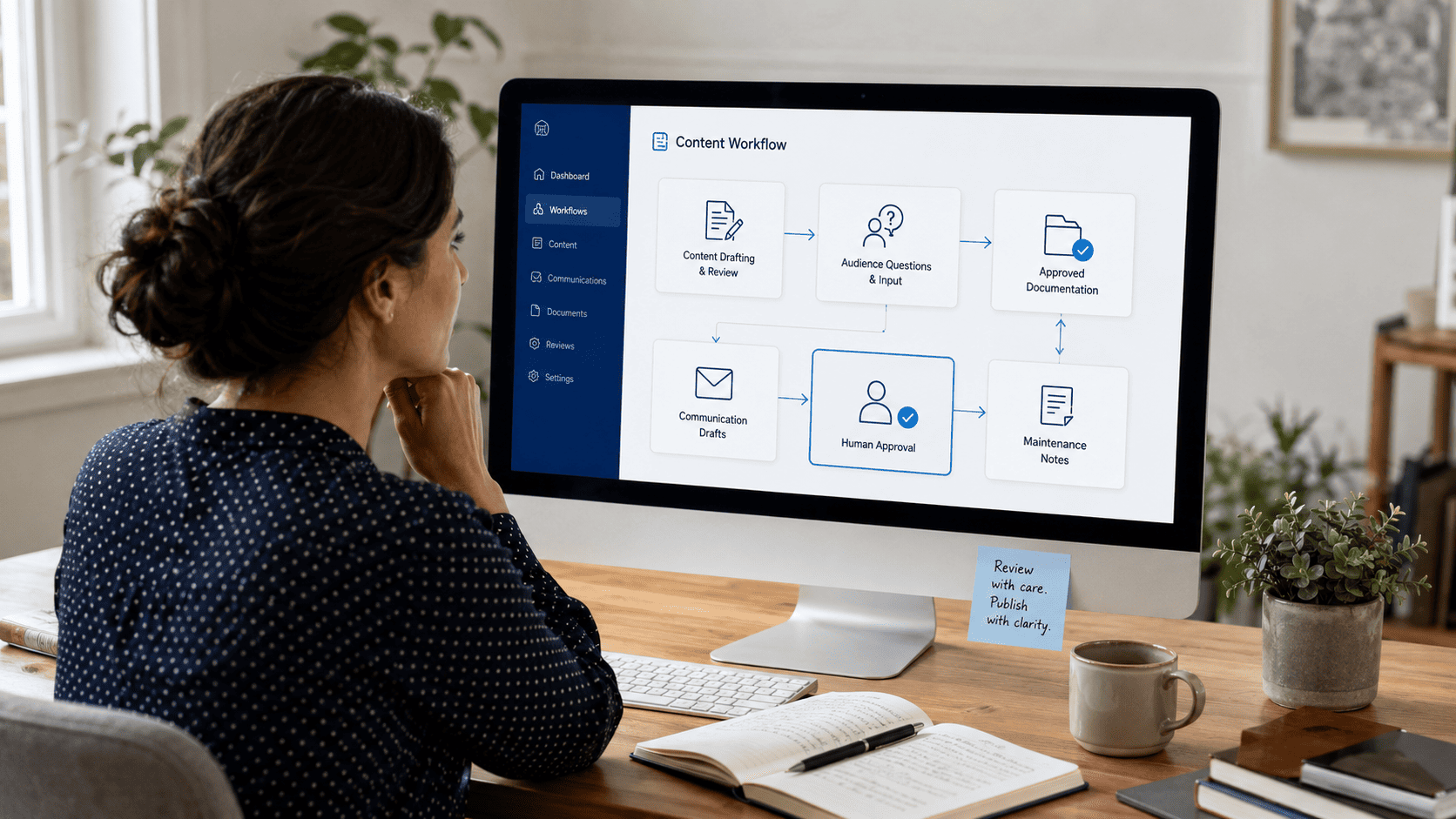
The practical value of connected workflows appears when each activity has a clear place in the overall system. An approved information source can inform a draft. The draft can move into human review. The approved output can be used or published. Later corrections, reader questions, or internal observations can be documented and considered during future updates.
This flow does not require constant automation. In fact, a responsible workflow may intentionally keep several transitions manual, especially when content becomes public, information is sensitive, or a decision affects other people.
| Workflow Stage | Purpose | Review Requirement |
|---|---|---|
| Approved Input | Provide relevant notes, documents, or generalized feedback for a defined task. | Remove unnecessary private information and confirm source suitability. |
| AI-Assisted Preparation | Organize, draft, compare, classify, or summarize material for review. | Treat the output as assisted material rather than approved final work. |
| Human Review | Check context, accuracy, clarity, privacy, tone, and suitability. | A responsible person decides whether revision or approval is needed. |
| Approved Use | Publish, store, communicate, or apply material only after review. | Preserve the approved version and its intended purpose. |
| Maintenance Feedback | Record corrections, questions, outdated material, or workflow concerns. | Use observations to guide careful updates rather than automatic expansion. |
This connected view is what makes AI-Powered Online Business Systems practical. AI assistance may contribute at selected points, but the workflow remains understandable because approved inputs, human review, final use, and maintenance responsibilities are all visible.
The visual summary below will bring these connected workflows together before we link back to the broader design framework that defines their purpose, boundaries, privacy safeguards, and oversight requirements.

Need the design foundation behind these connected workflows?
Connected digital workflows work well when their purpose, inputs, boundaries, privacy safeguards, and human review points are defined clearly before AI assistance is expanded.
Our guide to AI Business System Design explains this foundational framework for organizing responsible AI-assisted workflows with clarity and care.
Explore the AI Business System Design FrameworkKeeping Responsibilities Clear Across Connected Workflows
Once several workflows are connected, responsibility must remain visible at every transition. A content draft may move from approved notes to AI-assisted organization, then to editorial review and publication. A general audience question may move from collection to theme analysis, then to a content update. A document may move from draft status to an approved reference used by a team.
These transitions are practical only when the project can answer simple questions: where did the information come from, what assistance was used, what has been reviewed, who approved the output, and what should be updated later?
Within AI-Powered Online Business Systems, responsibility should not disappear as workflows become connected. It should become clearer. A responsible digital system records which material is still being prepared, which output has been checked, which information should remain private, and which decisions require a person rather than an automated action.
Clear responsibility is what allows AI-Powered Online Business Systems to connect several workflows without making their outputs difficult to trace, review, or correct.
Assign Responsibility at Workflow Handoffs
A workflow handoff occurs whenever material moves from one activity to another. Research notes may become an outline. An outline may become a draft. A draft may become a published article. Audience questions may become revision ideas. Approved documents may become reference material for future work.
At each handoff, there should be a clear understanding of what has changed and what still needs review. An AI-generated summary should not be treated as though it were the original source. A suggested revision should not be confused with an approved edit. A draft reply should not be sent as a final message unless the appropriate person has examined it.
This is particularly important for creators and small teams, where one person may handle several responsibilities. Clear workflow labels and review habits can prevent unfinished material, incorrect information, or unnecessary private details from moving forward unnoticed.
Separate Draft Material from Approved Material
Connected systems often contain different versions of the same material: notes, generated suggestions, rewritten drafts, edited copies, approved versions, and later updates. Without a clear distinction between these stages, a project may publish unfinished content, reuse outdated information, or rely on material that was never verified.
A responsible workflow should identify whether a document or output is:
- Source material: the original approved information used for a defined purpose.
- AI-assisted preparation: organized notes, summaries, comparisons, or draft suggestions awaiting review.
- Reviewed material: content examined by a responsible person and revised where necessary.
- Approved output: the version accepted for publication, communication, storage, or later reference.
- Maintenance record: corrections, update needs, or observations collected after use.
This distinction is practical rather than technical. Even a simple content site gains clarity from knowing which article draft has been checked, which image metadata is approved, which FAQ has been updated, and which older guidance may need a future review.
Keep Private Information Outside Unnecessary Workflows
When digital workflows are connected, information may pass through more than one task. A message may be summarized, classified, stored, reviewed, or used to guide a later response. This makes privacy considerations especially important.
A project should not include names, contact details, private messages, account information, unpublished records, or sensitive personal material simply because an AI tool can process them. In many cases, a generalized description or anonymized theme is enough for the intended workflow.
For example, a website owner who wants to refine an article may need to know that readers repeatedly struggle with a certain concept. The owner does not need detailed personal profiles of the readers who asked the question. Similarly, a small team reviewing recurring inquiry themes may be able to work from categories rather than storing unnecessary identifying details inside an AI-assisted process.
| Workflow Handoff | What Could Become Unclear | Responsible Practice |
|---|---|---|
| Notes to Draft | Generated wording may be mistaken for verified information. | Keep source notes available and label the draft for review. |
| Draft to Publication | Unchecked claims, unclear language, or unsuitable links may appear publicly. | Require a human publication check before the final version goes live. |
| Questions to Content Updates | Personal information may be collected unnecessarily. | Work from general themes or anonymized feedback wherever possible. |
| Document to Internal Reference | An older or unfinished version may be reused. | Maintain an approved version and record important revisions. |
| Draft Reply to Communication | A generated reply may not fit the situation or the person affected. | Review sensitive or consequential communication before sending. |
Clear handoffs keep connected workflows understandable. They also make problem correction more manageable, allow the source of a statement to be traced, protect private information, and clarify whether AI assistance remains appropriate for a particular task.
Review Points That Should Remain Human
AI assistance can prepare material for review, but some decisions should remain clearly human because they involve context, responsibility, audience impact, or sensitive information. In an online project, these decisions often appear when work becomes public, affects another person, or changes an approved resource.
The purpose of human review is not to reject practical technology. It is to ensure that assistance remains aligned with the project’s standards and with the people the work is intended to serve.
Publication and Public Content
Articles, tutorials, landing pages, newsletters, resource pages, and public updates can influence what readers understand or choose to rely upon. AI may assist with organizing notes, clarifying structure, identifying unclear passages, or preparing alternative drafts. Final publication should still involve a person checking facts, tone, wording, image information, internal links, and suitability for the intended reader.
A connected content workflow becomes more dependable when it makes this publication review explicit rather than assuming that a polished draft is ready to be published.
Sensitive or Consequential Communication
Routine, non-sensitive communication may sometimes be prepared with AI assistance, particularly when it involves general information already approved by the project. However, messages involving personal concerns, complaints, commitments, confidential details, disputes, policy interpretation, or decisions affecting another person require direct human attention.
The more a message depends on context and consequences, the less suitable it is for unattended handling. A responsible workflow recognizes this boundary before a problem occurs.
Changes to Approved Documents or Guidance
AI may compare versions, flag outdated sections, or suggest revisions to internal documentation and published guidance. Yet changing approved material can affect future content, team decisions, or reader understanding. Such changes should be reviewed by a person who can confirm whether the revision is accurate, necessary, and consistent with the purpose of the document.
Privacy and Information Boundaries
A person should remain responsible for deciding what information is suitable to enter an AI-assisted workflow. This includes reviewing whether private information is necessary, whether identifying details can be removed, whether source material has been approved, and whether the workflow stores or passes information in an appropriate way.
Human Review Reminder
In AI-Powered Online Business Systems, public content, sensitive communication, changes to approved guidance, and decisions about private information should remain subject to clear human responsibility.
Maintaining Trust Through Accurate and Appropriate Use
Trust develops when a digital project uses AI assistance carefully and communicates responsibly. Readers and users may not need to know every internal workflow detail, but they encounter clearer material when it is checked, respectful of privacy, and corrected when necessary.
For AI-Powered Online Business Systems, trust is not a promotional claim. It develops through consistent practices: reviewing public content, protecting information, avoiding unverified statements, using feedback to refine clarity, and keeping people accountable for important decisions.
Prioritize Reviewed Content Over Automated Volume
A content workflow should not be evaluated simply by how much material it can produce. Generating more drafts or publishing more frequently does not automatically serve readers. A smaller number of well-checked articles, tutorials, or resources may provide greater value when they address genuine needs and remain accurate over time.
AI assistance is most relevant when it allows a project to organize information, identify unclear explanations, prepare revisions, or maintain consistency without encouraging unnecessary output.
Use Audience Feedback Without Turning Readers into Data Points
Reader questions and feedback can reveal where an explanation needs refinement or where a topic deserves more careful coverage. AI may group recurring themes from approved or anonymized feedback, but the workflow should remain focused on serving readers rather than collecting information without a clear purpose.
A responsible system asks: What can we explain more clearly? What material needs an update? What recurring question can be addressed in a practical guide? It avoids assuming that every interaction should lead to further automated processing.
Correct and Document Problems When They Appear
No workflow is perfect. A summary may miss an important detail. A draft may include unclear language. A published resource may later need correction or clarification. A responsible system does not hide these limitations. It creates a practical path for identifying concerns, reviewing them, updating approved material, and recording what changed.
This practice is especially relevant for a digital publication or resource library, where earlier content may continue to be discovered by readers over time.
Common Operational Mistakes and Clearer Alternatives
Connected workflows can organize related activities, but they can also spread confusion more quickly when responsibilities are unclear. The following mistakes often occur when a project connects AI-assisted activities without sufficient review and documentation.
Passing Unchecked Material from One Workflow to Another
A generated outline, summary, classification, or draft may be suitable as preparation, but it should not automatically become approved input for another activity. When unchecked material moves through a system, inaccuracies or unclear assumptions may be repeated across several outputs.
A more responsible alternative is to identify review points before important material moves forward. For example, notes can be checked before they inform an article draft, and a draft can be reviewed before it informs a newsletter, social post, or resource update.
Automating Communication Without Understanding Context
A prepared reply may appear efficient, but communication often depends on tone, sensitivity, timing, and the needs of the person receiving it. Treating every request as routine can lead to inappropriate or confusing responses.
A more suitable alternative is to use AI assistance for organizing non-sensitive requests or preparing draft templates, while reserving direct review for messages that involve personal information, commitments, complaints, or other meaningful consequences.
Storing Information Without Clear Boundaries
When connected workflows collect notes, questions, documents, or communication records, it can become unclear what should be kept, what should be removed, and what should never enter an AI-assisted process.
A more responsible alternative is to document allowed inputs, minimize unnecessary information, remove identifying details when possible, and ensure that confidential material is not reused casually across tasks.
Adding More Automation Instead of Resolving the Real Problem
A workflow may appear slow or inconsistent because instructions are unclear, documents are outdated, responsibilities overlap, or source information is unreliable. Adding another automated activity does not necessarily solve any of these problems.
A more suitable alternative is to review the current process first: identify where confusion begins, clarify ownership, refine approved materials, and only then decide whether limited AI assistance is appropriate.
Treating Activity as Evidence of Quality
A system may generate more outputs, classify more information, or prepare more drafts while still producing material that is difficult to verify or unsuitable for its audience. Activity does not by itself show that a workflow is responsible or practical.
A more suitable alternative is to evaluate clarity, factual reliability, privacy handling, review efficiency, documentation quality, and the practical relevance of the final output.
| Operational Mistake | Possible Concern | Clearer Alternative |
|---|---|---|
| Moving Unchecked Drafts into Later Tasks | Errors or unverified statements may be repeated. | Create a visible review point before material is reused. |
| Using Automated Replies for Sensitive Situations | Tone, privacy, or context may be handled poorly. | Keep sensitive communication under human approval. |
| Collecting Unnecessary Information | Private details may enter connected workflows without a defined need. | Use limited, relevant, and anonymized inputs where possible. |
| Adding Tools to an Unclear Process | Complexity increases without resolving the source problem. | Clarify purpose, ownership, and documentation first. |
| Measuring Output Volume Alone | Quality or privacy concerns may be overlooked. | Review practical relevance, accuracy, privacy, and accountability. |
Evaluating Workflow Quality Without Chasing Activity Metrics
A responsible digital system should be evaluated according to what it allows people to do more clearly and safely, not merely according to how much activity it produces. This is especially important when AI assistance is involved, because the appearance of efficiency can hide unclear information, limited review practices, or unnecessary data handling.
Evaluation within AI-Powered Online Business Systems should therefore remain practical and human-centered. A creator or small team can periodically examine whether connected workflows still serve their purpose and whether their outputs remain understandable, reliable, and appropriate.
| Evaluation Area | Question to Review | Possible Refinement |
|---|---|---|
| Practical Relevance | Does the workflow contribute to clearer or more appropriate material? | Remove activities that add complexity without serving the intended user. |
| Accuracy | Are important claims checked before publication or use? | Clarify source-checking and approval requirements. |
| Privacy | Is only necessary and appropriate information entering the system? | Reduce, anonymize, or remove unnecessary inputs. |
| Reviewability | Can a person understand the source, status, and intended use of each output? | Label drafts clearly and preserve approved versions. |
| Communication Care | Are sensitive or consequential messages reviewed before sending? | Define communication categories that require human approval. |
| Maintenance | Are errors, outdated information, and workflow concerns recorded? | Create a simple revision record for important changes. |
Evaluation Reminder
A connected workflow is practical when it contributes to clearer work, appropriate information handling, visible review, and responsible updates. More activity alone is not evidence of responsible practice.
Maintaining AI-Powered Online Business Systems Responsibly Over Time
Connected workflows require occasional review because digital projects change. Articles are updated, audience questions evolve, internal documents become outdated, new communication needs appear, and a task that once used AI assistance may later require a different approach.
Maintenance does not mean continuously adding automation or tools. It means checking whether the current system remains understandable, appropriately limited, and aligned with its intended purpose.
Review Whether Each Workflow Still Has a Clear Purpose
A workflow that once served a clear need may become unnecessary or overly complicated. A digital project should occasionally examine whether an assisted activity still serves readers, editors, team members, or communication reviewers in a meaningful way.
When a workflow no longer has a clear purpose, simplifying or removing it may be more responsible than expanding it.
Keep Approved Materials Current
Connected systems depend on the quality of the documents and information they use. An older article, guidance page, template, checklist, or internal record may no longer reflect the project’s current standards or content direction.
Maintaining approved materials reduces the risk of outdated information being reused across future drafts, summaries, or responses. Where revisions are made, the project should preserve a clear approved version and note important updates.
Reassess Privacy and Input Boundaries
As workflows develop, it is practical to revisit the information they accept. A process that began with general material may gradually begin collecting more detailed input than the task requires. Reviewing these boundaries allows a project to avoid unnecessary exposure of private or identifying information.
A simple question can guide this review: does this workflow genuinely need this information in order to serve its stated purpose? When the answer is no, the information should not be included merely for convenience.
Record Corrections and Workflow Decisions
Corrections provide relevant signals. If a workflow repeatedly produces unclear wording, misses important context, includes unnecessary material, or requires the same manual adjustment, documenting that issue can guide process refinement.
A small record of revisions, approval decisions, recurring concerns, and boundary changes can make future review more manageable and reduce the risk of repeating preventable problems.
Remove Complexity That No Longer Serves the Project
A responsible AI-assisted system does not need to become more elaborate over time. Some tasks may be simplified. Some assisted activities may no longer be necessary. Some documents may be combined or archived. Some tools may add more confusion than practical value.
Maintaining the system therefore includes the ability to reduce complexity where it no longer serves readers, reviewers, or the purpose of the digital project.
| Maintenance Area | Review Question | Responsible Action |
|---|---|---|
| Purpose | Does this workflow still serve a genuine need? | Clarify, simplify, or remove activities that no longer serve the intended purpose. |
| Approved Materials | Are sources, templates, and documents current? | Update reviewed material and preserve clear approved versions. |
| Information Boundaries | Is the workflow receiving unnecessary private information? | Limit inputs and anonymize details where appropriate. |
| Review Points | Are important outputs still approved before use? | Restore or clarify human approval where needed. |
| Recorded Corrections | Do the same issues appear repeatedly? | Revise instructions, source material, or workflow boundaries. |
| Complexity | Has the system become harder to understand than necessary? | Remove duplicated tasks, unused tools, or unclear processes. |
A Responsible Maintenance Checklist for Connected Workflows
The practical purpose of AI-Powered Online Business Systems is not to remove human involvement from digital work. It is to connect selected activities in a way that makes preparation, review, approved use, and later maintenance clearer.
Before relying on any connected AI-assisted workflow, a creator or small team can review the following questions:
Connected Workflow Maintenance Checklist
- Is each workflow connected to a clearly defined purpose?
- Are source materials approved and appropriate for the task?
- Are AI-assisted drafts clearly separated from final approved material?
- Are private or identifying details excluded when they are not necessary?
- Are public outputs and sensitive communications reviewed by a person?
- Are important revisions, corrections, and approval decisions documented?
- Is the system evaluated for clarity and practical relevance rather than activity alone?
- Can unnecessary complexity be removed when it no longer serves the project?
The visual summary that follows can guide readers through these maintenance practices before moving to common questions about connected AI-assisted workflows and their responsible use.

FAQ About AI-Powered Online Business Systems
The following questions clarify how connected AI-assisted workflows can be used responsibly in digital projects while keeping human review, privacy, documentation, and practical maintenance visible.
What are AI-Powered Online Business Systems?
AI-Powered Online Business Systems are connected digital workflows where artificial intelligence assists with selected tasks such as organizing information, preparing drafts, grouping general questions, maintaining documentation, or reviewing recurring issues. The purpose is to make digital work clearer and more manageable to review, not to replace human responsibility.
How are connected workflows different from using separate AI tools?
Separate AI tools may assist with individual tasks, but connected workflows define how information moves from approved input to AI-assisted preparation, human review, final use, and later maintenance. This structure reduces confusion between drafts, reviewed material, and approved outputs.
Can creators and small teams use AI-Powered Online Business Systems?
Yes. A creator or small team can begin with a few practical workflows, such as content planning, editorial review, documentation organization, audience question grouping, or communication assistance. The system can remain simple as long as purpose, inputs, review points, and responsibilities are clear.
Which workflows may use AI assistance?
AI assistance may be appropriate for organizing approved notes, comparing article outlines, grouping general feedback themes, preparing non-sensitive draft templates, indexing documents, or identifying material that may need review. Public content, sensitive communication, and important decisions should remain subject to human approval.
Why should human review remain part of the system?
Human review matters because AI-assisted outputs may still contain unclear wording, missing context, unsuitable tone, factual errors, or information that should not be used. A responsible person should review public material, sensitive messages, approved documents, and privacy-related decisions before final use.
How can privacy be protected across connected workflows?
Privacy can be protected by using only the information needed for a defined task, removing identifying details where possible, working from generalized feedback themes, limiting access to sensitive material, and documenting what information should not enter an AI-assisted workflow.
What should be documented in an AI-assisted workflow?
A project should document approved sources, draft status, review responsibilities, final versions, important corrections, privacy boundaries, and maintenance decisions. This makes the workflow more manageable to understand, review, and refine without relying on memory or scattered notes.
How can AI-Powered Online Business Systems be refined over time?
AI-Powered Online Business Systems can be refined by reviewing recurring errors, unclear explanations, outdated documents, privacy concerns, communication issues, and user questions. The goal is not to add more automation automatically, but to adjust the workflow carefully where it contributes to clarity, practical relevance, and accountability.
Continue learning how to build responsible AI-assisted workflows
FutureTecEra shares practical guides on AI skills, content review, digital workflow design, privacy-aware practices, and human-centered ways to use artificial intelligence with clarity and care.
Subscribe to FutureTecEraConclusion: Connecting Digital Workflows with Care
AI-Powered Online Business Systems are most practical when they connect digital workflows in a way that remains understandable, reviewable, and responsible. Their value does not come from using more tools or automating every repeated task. It comes from knowing how information moves, where AI assistance is appropriate, who reviews important outputs, and how approved material is maintained over time.
A connected system may include content planning, editorial review, audience question organization, documentation, communication preparation, and workflow maintenance. Yet each of these activities still needs clear boundaries. AI-assisted material should be treated as preparation until it has been checked, revised where necessary, and approved for its intended use.
A responsible system does not need to be complex. A creator or small team can build a clear workflow by starting with approved inputs, keeping drafts separate from final versions, reviewing public and sensitive material, protecting private information, and documenting corrections when problems appear.
This approach reduces the risk of a digital project confusing activity with quality. More drafts, more summaries, or more automated actions do not automatically create clearer work. A responsible workflow should be evaluated by clarity, practical relevance, privacy awareness, reviewability, and the ability to refine the process without unnecessary complexity.
For FutureTecEra, the purpose of AI-assisted systems is not to remove human judgment from digital work. It is to guide people in organizing work more carefully, reviewing information more clearly, and maintaining digital projects with greater responsibility.