
Published by FutureTecEra

Responsible AI Adoption is not about using every new artificial intelligence tool as soon as it appears. It is about learning how to use AI with purpose, caution, human judgment, and clear boundaries.
As artificial intelligence becomes part of writing, research, education, productivity, business operations, customer support, design, and everyday digital workflows, beginners often face a practical challenge: how can they benefit from AI without depending on it blindly?
This guide from FutureTecEra explains Responsible AI Adoption as a simple, human-reviewed approach. Instead of treating AI as a shortcut or a magic solution, the goal is to understand where AI can help, where caution is needed, and how to build safer habits from the beginning.
A responsible approach matters because AI tools can produce helpful outputs, but they can also make mistakes, misunderstand context, reflect bias, or present uncertain information with confidence. That is why users should review important outputs, protect sensitive information, and keep final decisions human-led.
For beginners, responsible adoption does not require advanced technical knowledge. It starts with practical questions:
- What task do I want AI to support?
- What information should I avoid sharing?
- How will I check the output before using it?
- Does this tool improve clarity, quality, or organization?
- Where should human judgment remain in control?
This article will help you build a simple framework for choosing AI tools, protecting privacy, reviewing outputs, avoiding overreliance, and creating beginner-friendly workflows that remain useful, ethical, and realistic.
New to AI and digital learning?
Start with FutureTecEra’s beginner roadmap to understand the basics of artificial intelligence, digital skills, and practical learning before building your own responsible AI workflow.
Start HereWhat Responsible AI Adoption Means
Responsible AI Adoption means using artificial intelligence in a way that supports useful work while protecting accuracy, privacy, fairness, originality, and human accountability.
It is different from simply “using AI.” A person can use AI quickly and still use it poorly. For example, copying an AI answer without checking it, entering sensitive information into an unknown tool, or publishing generated content without review may create problems for trust, quality, and safety.
A responsible workflow is more careful. It starts with a clear purpose, uses the tool for a defined task, reviews the output, improves the result, and keeps important decisions under human control.
In practical terms, responsible AI use usually includes:
- Clear goals: knowing what task the tool should support.
- Privacy awareness: avoiding unnecessary personal, financial, health, or business data.
- Human review: checking important outputs before using them.
- Accuracy checks: verifying facts, numbers, sources, and sensitive claims.
- Originality: adding your own thinking, examples, voice, and judgment.
- Accountability: remembering that the user remains responsible for the final result.
This makes Responsible AI Adoption especially important for beginners. The goal is not to avoid AI. The goal is to use it with enough structure that it becomes a support system rather than a source of confusion or overdependence.
Why Responsible AI Adoption Matters for Beginners
Beginners often discover AI through tools that feel easy to use. A writing assistant can create a draft in seconds. A design tool can generate visual ideas quickly. A research assistant can summarize information that would normally take much longer to review.
This can be useful, but it can also create a false sense of confidence. When a tool responds quickly and clearly, users may assume the answer is accurate, complete, original, or safe to publish. In reality, AI outputs still need careful review.
Responsible AI Adoption matters because the goal is not simply to use artificial intelligence more often. The goal is to use it better. A responsible beginner learns how to ask clearer questions, protect private information, verify important details, and improve AI outputs before relying on them.
This is especially important in areas such as education, content creation, business communication, healthcare research, finance, legal topics, cybersecurity, and public information. In these areas, inaccurate or careless AI use can create confusion, damage trust, or lead to poor decisions.
For a beginner, the safest mindset is simple: AI can support your workflow, but it should not replace your judgment. You remain responsible for what you publish, submit, share, or decide.
The Difference Between Fast AI Use and Responsible AI Use
Fast AI use focuses only on output. It asks, “Can this tool create something quickly?” Responsible AI use asks better questions: “Is this output accurate? Is it useful? Is it original? Is it safe? Does it fit the context? Did I review it carefully?”
This difference matters because speed alone does not create quality. A fast draft can still be inaccurate. A polished answer can still miss context. A professional-looking visual can still be misleading. A useful summary can still leave out important details.
Responsible AI use adds a human layer to the process. It treats the AI output as a starting point, not the final result. This keeps the workflow practical, safer, and more aligned with real learning.
Responsible AI Adoption: 7 Smart Rules for Beginners
A beginner does not need a complex policy document to start using AI responsibly. What helps most is a small set of clear rules that can be repeated in different situations.
The following seven rules can guide Responsible AI Adoption whether you are using AI for learning, writing, research, planning, content creation, productivity, or simple business workflows.
| Rule | What It Means | Beginner Reminder |
|---|---|---|
| Start with a clear purpose | Use AI for a specific task, not because the tool is new or popular. | Define the goal before opening the tool. |
| Protect sensitive information | Avoid entering private, financial, health, business, or personal data unless you understand how the tool handles it. | When in doubt, keep sensitive details out. |
| Review every important output | Check facts, tone, structure, accuracy, and relevance before using the result. | AI output is a draft, not a final answer. |
| Keep human judgment visible | Use AI to support decisions, not to take full control of important choices. | You remain responsible for the final result. |
| Watch for bias and missing context | AI may reflect patterns from incomplete or unbalanced data. | Ask whether the answer is fair, complete, and context-aware. |
| Add your own thinking | Improve outputs with your experience, examples, voice, and goals. | Do not publish or submit AI text without personal review. |
| Build simple workflows | Use AI inside a repeatable process instead of jumping randomly between tools. | One useful workflow is better than ten disconnected tools. |
These rules help keep Responsible AI Adoption practical. They do not slow beginners down unnecessarily. Instead, they create a safer structure for learning, testing, improving, and using AI with more confidence.
How to Choose AI Tools Responsibly
Choosing an AI tool should not begin with popularity. A tool may be widely discussed online and still be a poor fit for your needs. A responsible choice begins with the task you want to improve.
Before choosing a tool, ask what problem you are trying to solve. Do you need help summarizing information? Organizing notes? Drafting outlines? Creating visuals? Reviewing grammar? Planning content? Managing repetitive tasks? Each goal may require a different type of tool.
For beginners, the best tool is usually not the most advanced one. It is the tool that is easy to understand, safe enough for your use case, clear about its limits, and useful inside your current workflow.
Questions to Ask Before Using a New AI Tool
- Purpose: What exact task will this tool support?
- Privacy: What kind of information will I enter into it?
- Control: Can I review, edit, and correct the output easily?
- Transparency: Does the tool explain its features, limitations, and data practices clearly?
- Quality: Does the tool improve the result, or does it simply make the process faster?
- Cost: Is the free or basic version enough for my current needs?
- Workflow fit: Does it support what I already do, or does it create more confusion?
These questions are useful because beginners often fall into tool overload. They test many platforms, save many links, watch many tutorials, and still feel unsure about how to use AI in a meaningful way.
A better approach is to choose one tool category, connect it to one real task, and practice until the workflow becomes clear. This makes learning easier and keeps Responsible AI Adoption focused on practical improvement rather than distraction.
A Simple Human-Reviewed AI Workflow
Responsible AI use becomes easier when you follow a repeatable workflow. This does not need to be complicated. A beginner can use a simple process that keeps the task clear and the final result human-reviewed.
A practical AI workflow may look like this:
- Define the task: Decide what you want AI to help with, such as outlining, summarizing, editing, planning, or brainstorming.
- Prepare safe context: Give enough information for the tool to help, but avoid sensitive personal or business details when they are not necessary.
- Generate a first output: Ask for a structured response, not a vague answer.
- Review the result: Check accuracy, tone, logic, missing details, and possible bias.
- Improve with your judgment: Add examples, refine the message, correct errors, and make the output fit your real goal.
- Use carefully: Publish, share, submit, or apply the result only after human review.
This workflow keeps the user in control. AI supports the process, but it does not decide the final outcome alone.
For example, a student may use AI to summarize a topic, but should still compare the answer with class notes and reliable sources. A creator may use AI to draft a content outline, but should still add original examples and personal voice. A small business owner may use AI to organize customer questions, but should still review tone and accuracy before responding.
This is the practical value of Responsible AI Adoption: it turns AI from a random tool into a structured assistant that supports clearer thinking, safer work, and better digital habits.
Privacy and Data Safety in Responsible AI Adoption
Privacy is one of the most important parts of Responsible AI Adoption. Many AI tools work better when users provide context, but not every type of information should be shared with every tool.
Beginners may accidentally enter private details because they want a more accurate answer. For example, they may paste personal documents, customer information, financial details, school records, private messages, business plans, or health-related information without checking how the tool handles that data.
A safer approach is to give AI only the context it needs. If a task can be completed with general information, avoid adding personal names, addresses, passwords, private numbers, confidential files, or sensitive business details.
Information Beginners Should Handle Carefully
- Personal information: names, addresses, phone numbers, identification details, private messages, or family information.
- Financial information: bank details, invoices, payment records, tax documents, or client financial data.
- Health information: symptoms, medical records, prescriptions, lab results, or personal health history.
- Business information: confidential strategies, customer lists, internal documents, private contracts, or unpublished plans.
- School or work records: private grades, evaluations, reports, internal notes, or sensitive emails.
This does not mean beginners should avoid AI completely. It means they should learn how to use AI with safer boundaries. A useful habit is to remove unnecessary details before pasting text into a tool. You can replace real names with general labels such as “client,” “student,” “customer,” or “project.”
Responsible privacy habits make AI workflows safer and more professional. They also help users build trust with readers, customers, students, team members, and anyone affected by the final output.
How to Review AI Outputs Before Using Them
One of the biggest mistakes beginners make is treating the first AI response as the final answer. AI can produce polished text, organized summaries, and confident explanations, but that does not mean the output is always accurate, complete, or appropriate.
A responsible review process helps you decide whether an AI output is ready to use, needs improvement, or should be rejected completely.
A Practical AI Output Review Checklist
| Review Area | Question to Ask | Why It Matters |
|---|---|---|
| Accuracy | Are the facts, names, numbers, dates, and claims correct? | AI can generate confident but incorrect information. |
| Context | Does the answer fit the real situation, audience, and purpose? | A technically correct answer can still be wrong for the context. |
| Tone | Does the output sound appropriate, respectful, and clear? | Tone affects trust, especially in public or professional content. |
| Originality | Have I added my own examples, judgment, and voice? | AI should support your work, not erase your perspective. |
| Safety | Does the output include sensitive, misleading, or risky information? | Some outputs should be edited, verified, or avoided before use. |
| Usefulness | Does this actually solve the task, or only look polished? | Good formatting is not the same as real value. |
This checklist is useful for writing, research, content planning, business communication, learning support, and many other beginner workflows. It keeps Responsible AI Adoption practical because it turns review into a repeatable habit.
The goal is not to distrust every AI output. The goal is to treat AI as a helpful assistant that still needs direction, correction, and human understanding.
Common Mistakes to Avoid When Using AI
Responsible AI use becomes easier when beginners understand the common mistakes that create confusion. Most problems do not happen because AI is useless. They happen because users expect too much from the tool or use it without a clear process.
- Using AI without a clear goal: When the task is vague, the output is often vague. A better approach is to define the audience, purpose, format, and expected result before asking.
- Sharing too much private information: Some users paste sensitive details into tools without checking privacy settings or data policies. A safer workflow uses only the information needed for the task.
- Publishing without review: AI-generated text may sound polished but still contain mistakes, weak logic, missing context, or unclear claims.
- Using too many tools at once: Tool overload can make learning harder. Beginners often progress faster when they master one useful workflow before adding more tools.
- Depending on AI for judgment-based decisions: AI can help organize options, but important decisions still need human responsibility, expertise, and context.
- Ignoring originality: A responsible user adds personal insight, examples, structure, and editing instead of copying outputs directly.
Avoiding these mistakes helps beginners build confidence without turning AI into a shortcut. The purpose of Responsible AI Adoption is to make artificial intelligence useful while keeping the user thoughtful and in control.
Responsible AI Adoption for Different Users
Responsible AI use does not look exactly the same for everyone. A student, creator, teacher, freelancer, small business owner, and team leader may use AI for different tasks. The principle remains the same: define the purpose, protect sensitive information, review outputs, and keep human judgment central.
For Students and Learners
Students can use AI to explain concepts, summarize notes, create practice questions, organize study plans, and review difficult topics. The responsible approach is to use AI as a learning assistant, not as a replacement for understanding.
A student should ask AI to explain, quiz, compare, simplify, or organize ideas. But copying answers without learning from them can weaken real understanding. The best use is active learning: ask questions, check the answer, rewrite it in your own words, and compare it with class material or trusted sources.
For Content Creators
Creators can use AI for brainstorming, outlining, title ideas, content calendars, summaries, and visual concepts. However, publishing strong content still requires originality, audience understanding, editing, fact-checking, and a clear message.
For creators, Responsible AI Adoption means using AI to support the creative process while keeping the final voice human. AI can help organize ideas, but the creator should decide what is accurate, useful, ethical, and aligned with the brand.
For Small Businesses
Small businesses can use AI to organize customer questions, draft basic replies, plan content, summarize feedback, prepare internal checklists, and reduce repetitive administrative work.
The responsible approach is to avoid using AI for sensitive customer decisions without review. Business communication should still be checked for tone, accuracy, privacy, and clarity before it reaches customers.
For Teams and Organizations
Teams need shared rules. If each person uses AI differently, the organization may face confusion around privacy, quality, ownership, and accountability.
A simple internal AI policy can explain what tools are allowed, what data should not be entered, which outputs require review, and who is responsible for final decisions. Even a short policy can make AI adoption safer and more consistent.
A Practical Example of Responsible AI Adoption
Imagine a beginner who wants to use AI to create a short educational article. A rushed workflow might look like this: ask AI for the article, copy the output, publish it quickly, and hope it performs well.
A responsible workflow looks different. The user first defines the audience and topic. Then they ask AI for an outline. After that, they review the structure, add personal examples, check key claims, improve the introduction, adjust the tone, and make sure the final article is useful and original.
In this example, AI supports the workflow, but it does not replace the user. The human still decides the purpose, verifies the information, improves the message, and takes responsibility for the final result.
This same pattern can apply to many tasks: creating a study plan, preparing a customer reply, summarizing research, organizing a content calendar, or planning a small project. The task may change, but the principle remains the same: AI helps, humans review.
That is the practical heart of Responsible AI Adoption. It does not reject technology, but it also does not trust automation blindly. It creates a balanced way to use AI with clarity, caution, and human direction.
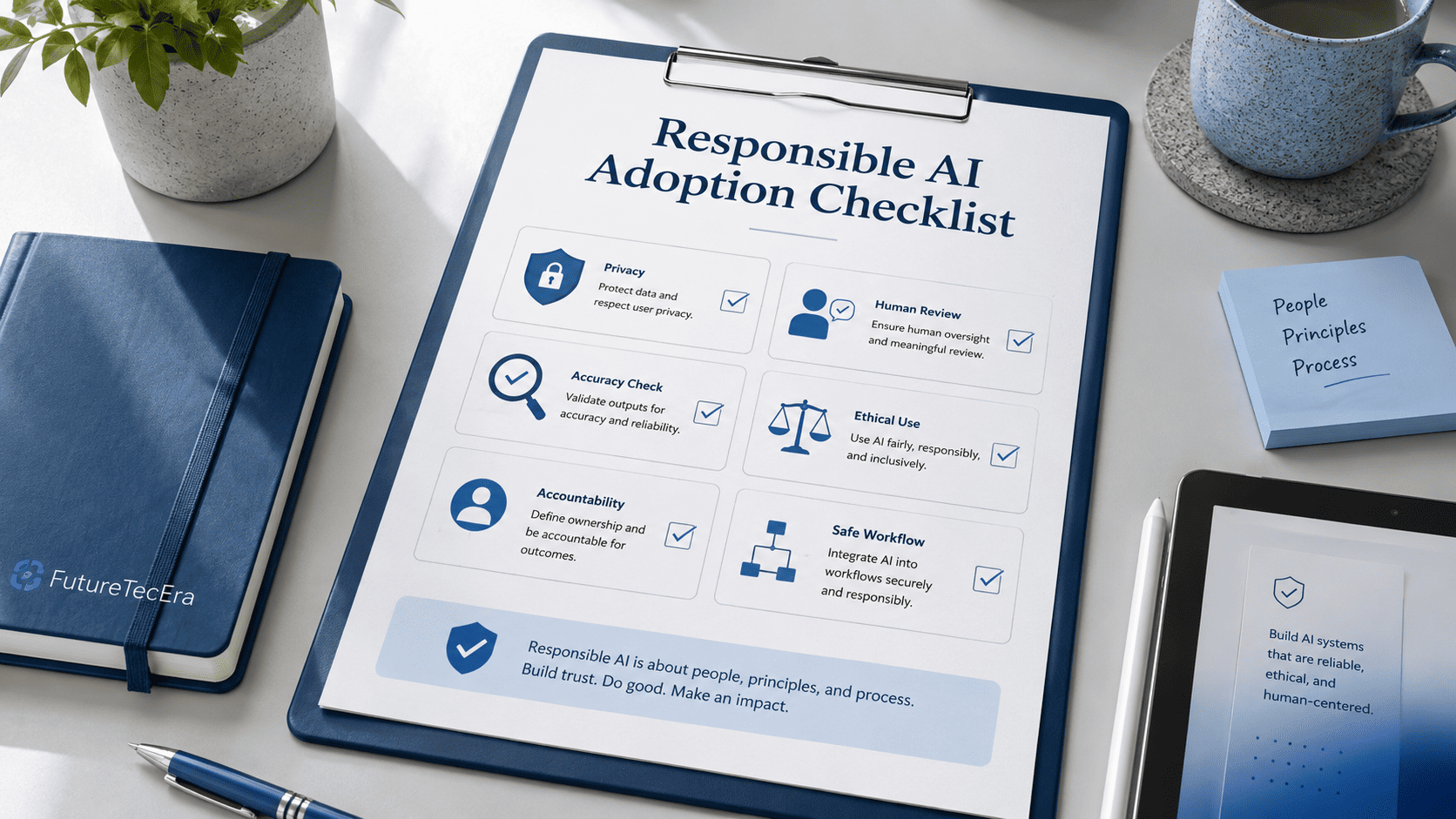
The following visual summarizes this responsible workflow: AI can support the process, but privacy, review, human judgment, and careful use should guide the final result.

Want to understand the bigger picture behind responsible AI use?
Continue with FutureTecEra’s beginner-friendly guide to the Future of Artificial Intelligence to explore how AI tools, ethics, trends, learning, and human judgment fit together.
Explore the Future of Artificial IntelligenceWhen AI Should Not Work Alone
A responsible AI workflow also means knowing when artificial intelligence should not be used alone. Some tasks are low-risk and can be supported by AI with simple review. Other tasks are sensitive and require stronger human expertise, professional judgment, or verified sources.
For example, using AI to brainstorm blog titles, organize notes, or create a study checklist is very different from using AI to make decisions about health, money, legal questions, hiring, safety, or private customer information.
Responsible AI Adoption becomes especially important when the output may affect real people, important decisions, public trust, or sensitive information.
Low-Risk AI Uses
Low-risk uses are tasks where mistakes are easy to notice, easy to correct, and unlikely to harm anyone. These can be good starting points for beginners.
- Brainstorming article ideas or content angles.
- Creating a first outline for a blog post or presentation.
- Summarizing your own notes for personal study.
- Generating practice questions for learning.
- Organizing a simple weekly task list.
- Improving clarity or grammar in non-sensitive text.
Even in low-risk tasks, review is still useful. The difference is that the consequences of a mistake are usually limited and easy to fix.
Higher-Risk AI Uses
Higher-risk uses require more caution. These are situations where inaccurate, biased, incomplete, or careless AI output could mislead people or create real problems.
- Health-related explanations or medical decisions.
- Financial advice, investment choices, or tax-related decisions.
- Legal interpretations, contracts, or compliance topics.
- Hiring, evaluation, grading, or decisions affecting people’s opportunities.
- Cybersecurity instructions, access control, or private system information.
- Public claims, statistics, or information that should be fact-checked.
In these cases, AI may help organize questions, summarize general concepts, or prepare a draft for review. But it should not replace qualified professionals, verified sources, or responsible human decision-making.
A safe beginner rule is simple: the more important the decision, the stronger the human review should be.
A Simple Risk-Level Framework for AI Use
Not every AI task carries the same level of risk. A practical way to support Responsible AI Adoption is to classify your task before using the tool.
This does not need to be complicated. Beginners can use a simple three-level framework: low risk, medium risk, and high risk.
| Risk Level | Typical AI Use | Review Needed | Beginner Action |
|---|---|---|---|
| Low Risk | Brainstorming, outlines, simple summaries, study prompts, idea organization. | Basic review for clarity, tone, and usefulness. | Use AI freely, but edit and personalize the result. |
| Medium Risk | Public content, business communication, research summaries, educational material. | Careful review for accuracy, context, originality, and claims. | Fact-check key points and add human judgment before publishing. |
| High Risk | Health, finance, legal, hiring, security, sensitive customer or personal data. | Strong human review, reliable sources, and professional oversight when needed. | Do not rely on AI alone. Use it only as support for organization or questions. |
This framework helps beginners avoid one of the most common problems in AI use: treating every task the same way. A title idea and a health-related decision do not require the same level of caution.
The purpose of this framework is not to make AI feel difficult. It is to help users match the tool to the responsibility of the task.
Building Your Personal AI Use Policy
A personal AI use policy is a short set of rules that guides how you use artificial intelligence in your learning, work, content, or daily productivity. It does not need to be formal or complicated.
For beginners, a personal policy can be as simple as a checklist you follow before using AI. The goal is to create consistency, avoid careless habits, and make your workflow easier to trust.
What Your Personal AI Policy Can Include
- Allowed uses: tasks where you feel comfortable using AI, such as outlines, brainstorming, summaries, or planning.
- Restricted uses: tasks where you need stronger review, such as public claims, business communication, or educational material.
- Not allowed: sensitive data, private documents, passwords, personal records, or confidential information you do not want processed by a tool.
- Review rules: how you check accuracy, tone, originality, and usefulness before using the output.
- Source rules: when you need to verify facts using reliable references or official sources.
- Disclosure rules: when you should be transparent that AI helped create or organize part of the work.
This kind of policy is useful for students, creators, freelancers, small business owners, and teams. It helps you avoid improvising every time you open an AI tool.
A personal policy also helps prevent overreliance. When you know what AI is allowed to support and what must remain human-led, your workflow becomes clearer and safer.
Responsible AI Adoption in Content Creation
Content creation is one of the most common areas where beginners use AI. AI can help with titles, outlines, drafts, introductions, summaries, social media captions, image ideas, and content calendars.
However, content creation also requires care. AI-generated content can sound polished while still being generic, inaccurate, repetitive, or disconnected from the audience. Publishing content too quickly can weaken trust, especially if the article makes claims that were not checked.
A responsible creator uses AI as a planning and drafting assistant, not as the full author of the final work.
A Responsible Content Workflow
- Define the audience: know who the content is for and what problem it should help solve.
- Use AI for structure: ask for outlines, section ideas, angles, and questions readers may have.
- Add your own experience: include examples, observations, brand voice, and practical context.
- Check facts: verify important claims, tool names, dates, statistics, and recommendations.
- Edit for originality: remove generic wording and make the content useful for real readers.
- Review for safety: avoid exaggerated claims, sensitive promises, or misleading conclusions.
This approach is especially useful for websites that want to build long-term trust. In content creation, Responsible AI Adoption is not only about avoiding mistakes. It is also about protecting the quality and identity of the website.
Responsible AI Adoption in Learning and Education
AI can be a helpful learning companion when it is used correctly. It can explain difficult concepts, generate practice questions, simplify complex topics, organize study notes, and help learners compare ideas.
The risk is that learners may use AI only to get answers instead of building understanding. This can create a false feeling of progress. A student may finish a task quickly but still fail to understand the topic deeply.
A responsible learning workflow uses AI to support thinking, not replace it.
Better Ways to Use AI for Learning
- Ask AI to explain a concept in simpler language.
- Request examples, comparisons, or practice questions.
- Ask the tool to quiz you instead of giving you the final answer immediately.
- Rewrite the explanation in your own words to check understanding.
- Compare the answer with class notes, books, or trusted learning sources.
- Use AI to organize revision, not to avoid effort.
This method makes AI more valuable because it keeps the learner active. The learner is not only receiving information. They are questioning, rewriting, testing, and improving their understanding.
For education, Responsible AI Adoption means protecting curiosity, effort, and critical thinking. AI can make learning more flexible, but real understanding still requires attention and practice.
Responsible AI Adoption for Small Businesses and Teams
Small businesses and teams often adopt AI because they want to save time, organize work, improve communication, or reduce repetitive tasks. These are valid reasons, but AI should not be added to a workflow without clear rules.
A small business may use AI to draft customer replies, summarize feedback, organize FAQs, create content outlines, prepare internal checklists, review documents, or plan simple campaigns. These uses can be helpful when they are reviewed carefully and connected to real business needs.
However, problems can appear when teams use AI without shared expectations. One person may enter sensitive customer data into a tool. Another may publish AI-generated text without checking accuracy. Someone else may rely on automation for a decision that should be reviewed by a human.
This is why Responsible AI Adoption is especially important for teams. The goal is not to block AI use. The goal is to make AI use clearer, safer, and easier to manage.
What Small Teams Should Clarify First
- Approved use cases: define which tasks AI can support, such as drafting, summarizing, brainstorming, research organization, or internal planning.
- Restricted information: decide what data should never be entered into AI tools, such as private customer records, passwords, confidential contracts, or sensitive business documents.
- Review responsibility: clarify who checks AI-assisted work before it is published, sent, or used in a decision.
- Quality standards: explain what makes an output acceptable, including accuracy, tone, originality, usefulness, and alignment with the brand.
- Tool boundaries: decide whether the team can use public tools, paid tools, internal tools, or only approved platforms.
These rules do not need to be complicated. Even a simple one-page internal guide can prevent confusion and help teams use AI more responsibly.
For small businesses, responsible adoption is not about using AI everywhere. It is about choosing a few practical workflows where AI can support clarity, organization, and consistency without weakening trust.
How to Build an AI Review System
A review system is one of the strongest safeguards in any AI workflow. It helps users avoid publishing weak, inaccurate, risky, or generic outputs simply because they look polished.
Beginners often think review means only correcting grammar. In reality, AI review is broader. It includes checking facts, tone, privacy, usefulness, originality, and whether the output fits the real situation.
A simple review system can include three layers: basic review, content review, and responsibility review.
| Review Layer | What to Check | When It Matters Most |
|---|---|---|
| Basic Review | Grammar, clarity, formatting, repetition, and readability. | Any AI-assisted text, notes, outlines, or drafts. |
| Content Review | Accuracy, missing context, weak claims, examples, and usefulness. | Articles, emails, educational material, research summaries, and public content. |
| Responsibility Review | Privacy, bias, sensitive claims, user impact, and final accountability. | Business communication, customer support, health, finance, legal, hiring, education, or public information. |
This review system helps users match the level of review to the importance of the task. A private brainstorming note may need only a basic review. A public article, customer message, or educational guide needs more careful checking.
For teams, it can be helpful to assign review roles. One person may check accuracy, another may review tone, and another may confirm whether the final result aligns with the organization’s standards.
For individuals, the same idea can be simpler. Before using an AI output, pause and ask: Is it accurate? Is it safe? Is it useful? Does it sound like me? Would I be comfortable taking responsibility for it?
Measuring Whether AI Is Actually Helping
One common mistake in AI adoption is assuming that faster work automatically means better work. Speed can be useful, but it is not the only measure of value.
A responsible user should ask whether AI improves the quality of the workflow, not only whether it produces something quickly. Sometimes AI saves time. Sometimes it creates extra editing work. Sometimes it helps organize ideas. Sometimes it introduces errors that need careful correction.
To evaluate AI use more clearly, measure practical signals rather than vague excitement.
Useful Signals to Track
- Clarity: Does AI help make the task easier to understand?
- Time saved: Does it reduce repetitive work without lowering quality?
- Accuracy: Are fewer mistakes appearing after review?
- Consistency: Does it help create a more repeatable workflow?
- Creativity support: Does it help generate useful ideas without replacing human direction?
- Trust: Does the final output feel reliable, honest, and appropriate for the audience?
- Learning: Does the user understand more after using AI, or become more dependent on it?
These signals make Responsible AI Adoption more practical. They help you decide whether a tool deserves a place in your workflow or whether it is only adding noise.
A tool that saves ten minutes but creates inaccurate or generic work may not be worth using. A tool that helps you organize thinking, ask better questions, and produce clearer results may be valuable even if it still requires editing.
The goal is not to use AI as much as possible. The goal is to use it where it genuinely improves clarity, quality, organization, or learning.
Building Trust in AI-Assisted Work
Trust is one of the most important outcomes of responsible AI use. Whether you are writing an article, helping a student, replying to a customer, preparing a presentation, or organizing business information, people need to trust the final result.
AI-assisted work can lose trust when it sounds generic, makes unsupported claims, hides uncertainty, copies a style without adding value, or appears careless. On the other hand, AI-assisted work can be useful when it is reviewed, improved, and clearly guided by human judgment.
Building trust does not require announcing every small AI-assisted action. But it does require honesty, accuracy, originality, and responsibility.
Trust-Friendly AI Habits
- Do not exaggerate: avoid claims that promise perfect results, instant success, or guaranteed outcomes.
- Verify important details: check facts, names, numbers, dates, and technical statements before using them.
- Keep the human voice: edit AI outputs so they reflect your real message, brand, experience, or teaching style.
- Respect privacy: do not expose personal, customer, student, or business information unnecessarily.
- Be clear about limits: when a topic is uncertain or sensitive, avoid presenting AI output as final authority.
- Use AI to support quality: let AI help organize or draft, but make the final result useful through human review.
These habits are especially important for websites, educators, creators, freelancers, and small businesses. Audiences do not only judge whether content is fast or polished. They judge whether it is useful, honest, and reliable.
This is why Responsible AI Adoption is closely connected to long-term trust. The more AI becomes part of digital work, the more important human judgment becomes.
Responsible AI Adoption Checklist
Before using AI output in a real workflow, it helps to follow a short checklist. This checklist can be used by beginners, creators, students, small business owners, and teams.
| Checklist Question | Why It Matters |
|---|---|
| Did I define the task clearly? | A clear task usually produces a more useful output. |
| Did I avoid sensitive information? | Protects privacy and reduces unnecessary data exposure. |
| Did I review the output carefully? | AI can make mistakes even when the answer sounds confident. |
| Did I check important facts? | Accuracy matters for trust, especially in public or educational content. |
| Did I add human judgment? | Your context, examples, and decisions make the result more useful. |
| Did I consider bias or missing context? | AI may produce incomplete or one-sided outputs. |
| Would I take responsibility for this result? | If the answer is no, the output needs more review or should not be used. |
This checklist can become part of your personal or team workflow. Over time, it helps create safer habits and more consistent AI-assisted work.
The best AI users are not the ones who accept every output quickly. They are the ones who know how to guide tools, review results, protect trust, and improve the final outcome with human judgment.
Final Framework for Responsible AI Adoption
By this point, Responsible AI Adoption should feel less like a technical concept and more like a practical habit. The goal is not to make AI use complicated. The goal is to make it safer, clearer, and more useful.
A strong beginner framework can be summarized in a simple idea: use AI for support, but keep humans responsible for direction, review, and final decisions.
Before using AI in any important workflow, ask yourself:
- Do I know what task I want AI to support?
- Have I avoided sharing sensitive information?
- Do I understand the limits of this tool?
- Will I review the output before using it?
- Does the final result still include human judgment?
These questions are simple, but they can prevent many common problems. They help beginners avoid overreliance, protect privacy, improve quality, and use AI in a way that supports learning rather than replacing thinking.
For individuals, this framework builds better digital habits. For creators, it protects originality and trust. For small businesses, it supports safer workflows. For teams, it creates consistency. For learners, it keeps understanding at the center.
That is why Responsible AI Adoption is not only about tools. It is about mindset, process, and accountability.

Frequently Asked Questions About Responsible AI Adoption
What does Responsible AI Adoption mean?
Responsible AI Adoption means using artificial intelligence with clear goals, privacy awareness, human review, accuracy checks, and ethical judgment instead of relying on AI outputs blindly.
Why is human review important when using AI?
Human review is important because AI can make mistakes, miss context, reflect bias, or produce confident but incomplete answers. Reviewing outputs helps protect accuracy, trust, and responsibility.
What information should I avoid sharing with AI tools?
You should avoid sharing sensitive information such as passwords, private personal details, financial records, health information, confidential business documents, customer data, or anything you do not want processed by a tool.
Can beginners use AI responsibly without technical skills?
Yes. Beginners can use AI responsibly by starting with simple tasks, protecting private information, checking outputs carefully, learning the limits of each tool, and keeping final decisions human-led.
How can small businesses adopt AI responsibly?
Small businesses can adopt AI responsibly by defining approved use cases, protecting customer data, training team members, reviewing AI-assisted work, and using AI only where it improves clarity, quality, or organization.
What is the safest way to start using AI?
The safest way to start using AI is to choose one low-risk task, use one tool category, avoid sensitive data, review the output carefully, and improve the result with your own judgment before using it.
Want more practical guides on AI and responsible digital systems?
Join the FutureTecEra community for clear, beginner-friendly insights about artificial intelligence, digital skills, human review, and safer technology workflows.
Subscribe to FutureTecEraConclusion: Responsible AI Adoption Starts with Human Judgment
Responsible AI Adoption is not about rejecting artificial intelligence. It is about using AI with enough structure, caution, and human review to make the technology genuinely useful.
AI can support writing, learning, research, planning, customer communication, business workflows, content creation, and productivity. But its value depends on how carefully it is used. A helpful tool can still create problems if users share sensitive data, skip review, ignore context, or treat automation as a final authority.
For beginners, the best path is simple: start with low-risk tasks, define clear goals, protect private information, review outputs carefully, and build small workflows that can improve over time.
For creators and small businesses, responsible AI use helps protect trust. It encourages originality, accuracy, transparency, and better review habits. It also prevents AI from becoming a shortcut that weakens quality or creates confusion.
For teams and organizations, responsible adoption requires shared rules. Even simple guidance around approved tools, restricted data, review steps, and final accountability can make AI use safer and more consistent.
At FutureTecEra, the message is clear: AI should support people, not replace thoughtful decision-making. The strongest AI workflows are the ones that combine useful tools with privacy awareness, ethical habits, practical review, and human judgment.
If you are just beginning, do not try to use every AI tool at once. Start with one clear task, one safe workflow, and one habit of careful review. That is how Responsible AI Adoption becomes practical, sustainable, and trustworthy.